
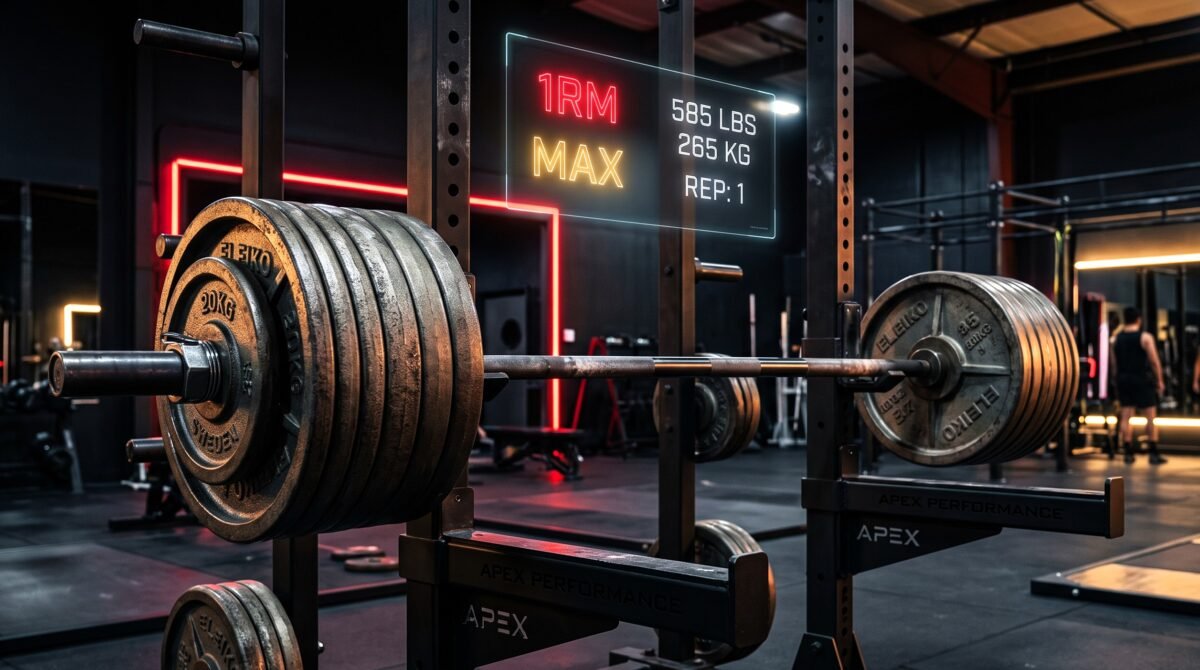
The Ultimate One Rep Max (1RM) Calculator
In the world of bodybuilding and powerlifting, progress is measured in numbers. Whether your goal is to build Golden Era muscle mass or hit a new personal best on the bench press, you need to know exactly how strong you are.
However, constantly testing your absolute maximum strength (lifting a weight you can only lift exactly one time) is highly dangerous, taxes your central nervous system, and often leads to injury.
That is where our One Rep Max (1RM) Calculator comes in. Using the scientifically proven Epley Formula, this tool safely estimates your 1RM based on the weights and reps you can already perform comfortably.
One Rep Max (1RM) Calculator
Calculate your absolute maximum strength for a single repetition and discover your optimal training zones.
Why Do You Need to Know Your 1RM?
Knowing your 1RM is not just for bragging rights; it is the most crucial data point for designing an effective workout program. Without knowing your 1RM, you are just guessing which weights to pick up.
1. Safe Strength Testing
Attempting a true 1-rep max requires perfect form, mental preparation, and reliable spotters. If you are training alone, going for a 1RM on a squat or bench press can be life-threatening. Our calculator allows you to push yourself safely for 5 or 8 reps, and then accurately predicts what your 1-rep max would be without the risk.
2. Finding Your Training Zones
The secret to building a classic physique or brute strength lies in “percentages.” Different percentages of your 1RM trigger different physiological adaptations in your body. Our calculator doesn’t just give you one number; it generates a complete breakdown of your training zones:
- Max Strength (85% – 100% of 1RM): Heavy weights lifted for 1 to 5 reps. This zone forces your central nervous system to adapt, making you significantly stronger without necessarily adding a lot of bulk.
- Hypertrophy/Muscle Growth (70% – 85% of 1RM): Moderate weights lifted for 6 to 12 reps. This is the “Golden Era” zone. It creates the perfect balance of mechanical tension and metabolic stress to trigger massive muscle growth.
- Muscular Endurance (Below 70% of 1RM): Lighter weights lifted for 15+ reps. This builds stamina, improves blood flow (the pump!), and conditions your muscles for sustained effort.
How to Use the 1RM Calculator Effectively
To get the most accurate estimation of your 1-rep max, follow these guidelines:
- Warm Up Properly: Never attempt a heavy set cold. Do several lighter sets to prime your muscles, joints, and nervous system.
- Pick a Challenging Weight: Choose a weight that you can lift with perfect form for 3 to 8 repetitions.
- Go to Failure (or Close to It): The reps you enter into the calculator should be a true representation of your strength. If you enter 5 reps, it should mean you physically could not have completed a 6th rep with good form.
- Use the Right Exercises: This calculator works best for major compound movements like the Barbell Bench Press, Back Squat, Deadlift, and Overhead Press. It is less accurate for isolation exercises like bicep curls or lateral raises.
Frequently Asked Questions (FAQ)
Is the One Rep Max Calculator 100% accurate?
While no formula is perfect, the Epley formula used in our calculator is widely regarded as one of the most accurate in sports science. Keep in mind that calculations are most accurate when you input reps between 1 and 10. If you enter a weight you lifted for 20 reps, the 1RM estimation becomes less reliable.
How often should I test or calculate my 1RM?
You don’t need to recalculate your 1RM every week. A good rule of thumb is to test your strength levels every 4 to 6 weeks at the end of a training block. This allows you to adjust your percentages for your next training cycle.
Can beginners use a 1RM calculator?
Yes! In fact, it is much safer for beginners to use a calculator than to attempt a physical 1RM lift, as their form and joint stability are still developing. Beginners should stick to the 70%-80% Hypertrophy zone to safely build foundational muscle and perfect their technique.