
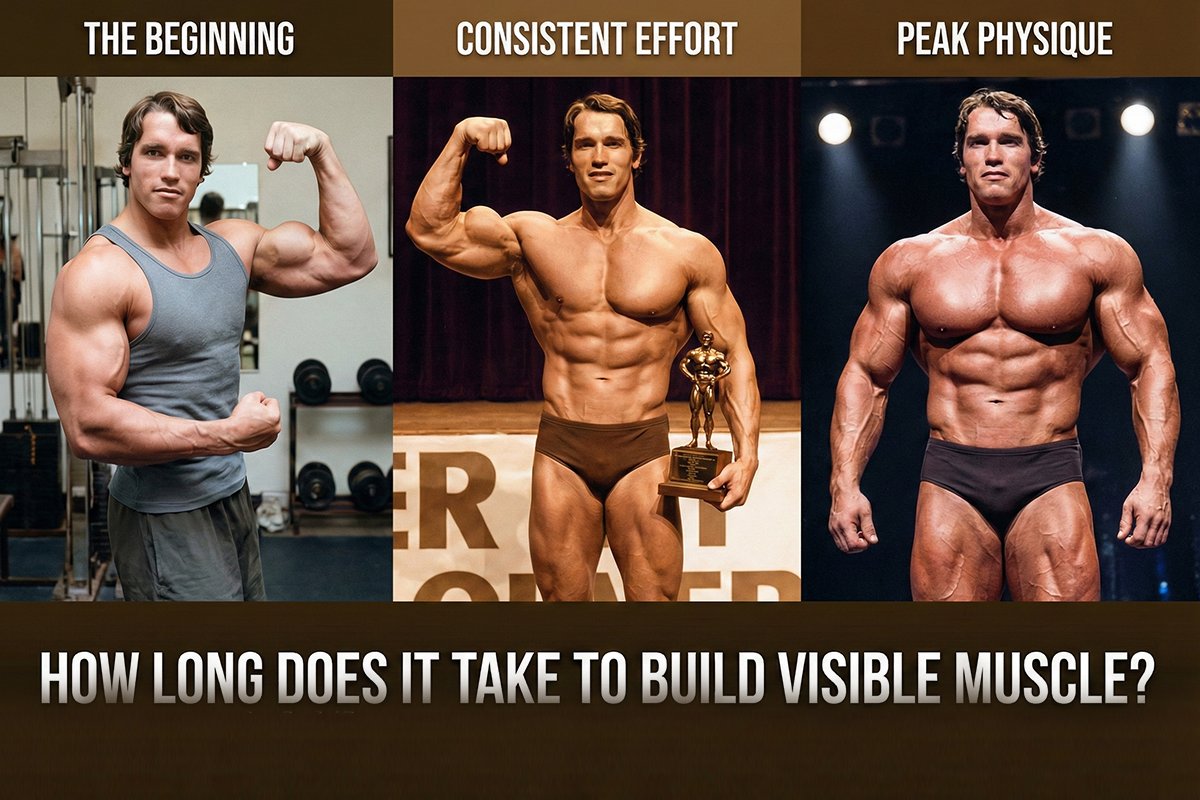
1. Introduction: The Architecture of Patience in a High-Speed World
In the contemporary landscape of health and fitness, the most pervasive question—and the source of the most profound frustration—is a temporal one: “How long does it take?” The digital age has compressed our perception of time, fostering an expectation of immediacy that is fundamentally at odds with human physiology. Social media platforms, particularly TikTok and Instagram, have created a distorted reality where “transformations” appear to occur in weeks rather than years.1 This report aims to dismantle these misconceptions, replacing the ephemeral promise of “quick fixes” with a rigorous, evidence-based analysis of the biological timeline of muscle growth.
The quest for visible muscle is not merely a vanity project; it is a physiological endeavor that requires the orchestration of neurological, hormonal, and structural adaptations. To answer the question of duration, we must first define the destination. “Visible muscle” is a composite metric. It is not solely the result of hypertrophy (the accretion of contractile tissue) but is inextricably linked to body composition (the reduction of adipose tissue). A trainee may build ten pounds of lean mass, but if that mass remains concealed beneath a layer of subcutaneous fat, the visual result remains static.3 Thus, the timeline for visible muscle is a dual timeline of building and revealing.
This document serves as an exhaustive guide for the natural trainee. It synthesizes data from peer-reviewed literature, expert consensus models from researchers such as Alan Aragon and Lyle McDonald, and physiological principles governing sarcopenia, hormonal fluctuations, and genetic ceilings. By establishing realistic benchmarks, we empower the trainee to navigate the “invisible” phases of growth without losing motivation, grounding their expectations in the slow, consistent rhythm of biological adaptation.
2. The Physiology of Growth: Mechanisms of Hypertrophy
To understand the timeline, one must first understand the mechanism. Muscle growth does not occur during the training session; the gym is merely the stimulus, the architect’s blueprint. The construction occurs during the recovery phase, a complex cascade of cellular events that requires time, energy, and raw materials.
2.1 The Cellular Cascade: From Stimulus to Synthesis
Skeletal muscle hypertrophy is defined as an increase in the size of muscle fibers, specifically the cross-sectional area (CSA). This growth is primarily driven by an increase in the volume of myofibrils—the contractile filaments actin and myosin—and the sarcoplasm, the fluid surrounding them.
The Three Primary Drivers
Research has historically identified three primary mechanisms of hypertrophy:
- Mechanical Tension: This is the most potent driver. When a muscle is stretched and contracted under load, mechanosensors within the sarcolemma (muscle cell membrane) detect the physical force. This mechanical signal is transduced into a chemical signal, primarily activating the mTORC1 (mechanistic target of rapamycin complex 1) pathway. mTOR is the master regulator of protein synthesis, acting as the cellular “on” switch for growth.5
- Metabolic Stress: Often associated with the “pump,” this involves the accumulation of metabolites (lactate, hydrogen ions, inorganic phosphate) during sustained anaerobic glycolysis. This stress signals a hormonal response and cell swelling, which may independently stimulate growth or enhance the mechanical tension signal.5
- Muscle Damage: Micro-tears in the Z-disks of the muscle sarcomere trigger an inflammatory response. While once thought to be a primary driver, current research suggests damage is more of a side effect of tension rather than a requirement. However, the repair process does facilitate the remodeling of tissue.6
The Role of Satellite Cells and Myonuclei
A critical and often overlooked component of the timeline is the role of satellite cells. Muscle fibers are unique in that they are multinucleated; a single cell contains hundreds or thousands of nuclei. Each nucleus can only manage a specific volume of cytoplasm—a concept known as the myonuclear domain.5
When a muscle fiber grows, it eventually reaches the limit of its myonuclear domain. To grow further, it requires more nuclei. Satellite cells, which are muscle stem cells located between the basal lamina and sarcolemma, are activated by mechanical trauma. They proliferate and fuse to the existing muscle fiber, donating their nuclei. This addition of myonuclei is a relatively slow biological process, which partly explains why rapid muscle growth is physiologically impossible. The body must physically upgrade the cellular machinery before it can sustain larger tissue.5
2.2 The Neural Phase: The “Phantom” Gains (Weeks 0–6)
When a sedentary individual initiates a resistance training program, the initial results are deceptive. Strength levels often skyrocket within the first month. A novice might struggle to bench press 40kg on Day 1 and comfortably lift 50kg by Day 30. However, ultrasound and biopsy studies consistently show that measurable hypertrophy is negligible during this period.9
This phenomenon is Neuromuscular Adaptation.
- Motor Unit Recruitment: The central nervous system (CNS) learns to recruit high-threshold motor units that were previously dormant.
- Rate Coding: The firing frequency of motor neurons increases, generating more force.
- Inter-muscular Coordination: The body learns the skill of the movement, reducing the co-activation of antagonist muscles (e.g., the triceps relaxing while the biceps contract).
Implication for the Timeline: The first 4 to 8 weeks of training are characterized by “phantom gains.” The trainee becomes significantly stronger and more capable, but the mirror reflects little change. This is a critical psychological hurdle; the biological foundation is being laid, but the visual structure has not yet risen above ground.11
2.3 The Hypertrophic Phase: Structural Differentiation (Weeks 8+)
True structural hypertrophy typically becomes the dominant driver of strength gains only after the initial neural adaptations have plateaued, usually around the 8-to-12-week mark for beginners.
- Ultrasound Visibility: Studies indicate that while markers of swelling (edema) can simulate growth early on, actual accretion of contractile protein is rarely statistically significant before week 8 to week 12.10
- Visual Visibility: For the naked eye to perceive a change, the muscle must grow enough to press against the skin and alter the silhouette. Depending on body fat levels, this typically requires 3 to 6 months of consistent training.9
3. Quantifying Expectations: The Models of Potential
In a domain rife with subjectivity, we must rely on statistical models to set realistic boundaries for growth. The “Newbie Gains” phenomenon creates a non-linear growth curve: rapid initial progress followed by an exponential decay in rate as the trainee approaches their genetic ceiling.
3.1 The Lyle McDonald Model: Training Age
Physiologist Lyle McDonald proposes a model based on “Years of Proper Training.” This distinction is vital; five years of sporadic, low-intensity exercise does not equate to five years of “proper” training.
Table 1: Lyle McDonald’s Generic Bulking Routine (GBR) Growth Model
| Years of Proper Training | Potential Annual Muscle Gain (Lbs) | Potential Annual Muscle Gain (Kg) | Average Monthly Gain (Lbs) |
| Year 1 | 20 – 25 lbs | 9 – 11.3 kg | ~2.0 lbs |
| Year 2 | 10 – 12 lbs | 4.5 – 5.4 kg | ~1.0 lb |
| Year 3 | 5 – 6 lbs | 2.3 – 2.7 kg | ~0.5 lb |
| Year 4+ | 2 – 3 lbs | 1 – 1.4 kg | Negligible |
Source: Synthesized from 13
Analysis of Table 1:
- The “Golden Year”: The first year offers a unique physiological window where the body is hypersensitive to stimulus. Gaining 20+ pounds of lean tissue is transformative. A male weighing 150 lbs could finish his first year at 170-175 lbs with a similar body fat percentage, looking like a completely different person.
- The Sharp Decline: By Year 3, a lifter fights for mere ounces. This is not a failure of programming; it is the reality of approaching the asymptote of genetic potential.13
3.2 The Alan Aragon Model: Relative Growth
Alan Aragon, a leading researcher in sports nutrition, frames growth potential as a percentage of total body weight. This model accounts for the fact that larger individuals generally have a larger absolute capacity for mass accrual.
Table 2: Alan Aragon’s Rate of Muscle Gain
| Training Status | Monthly Gain (% of Body Weight) | Estimated Gain for 170lb Male |
| Beginner | 1.0% – 1.5% | 1.7 – 2.5 lbs |
| Intermediate | 0.5% – 1.0% | 0.8 – 1.7 lbs |
| Advanced | 0.25% – 0.5% | 0.4 – 0.8 lbs |
Source: Synthesized from 15
Analysis of Table 2:
- The Scale Deception: For an advanced lifter gaining 0.4 lbs of muscle a month, the bathroom scale is a useless tool. Daily fluctuations in hydration (water weight), glycogen (carb stores), and intestinal content can swing weight by 3-5 lbs in a single day. Thus, relying on the scale to track muscle growth in the short term is a fool’s errand. This necessitates other metrics: gym performance, tape measurements, and progress photos.18
3.3 The “Paper Towel” Analogy
The visibility of these gains is governed by the “Paper Towel Effect.”
- The Concept: Imagine a full roll of paper towels. Removing five sheets (losing fat) or adding a layer (gaining muscle) barely changes the diameter visually. However, as the roll gets smaller (leaner), removing or adding the same amount of paper yields a dramatic visual change.
- Implication: A trainee at 25% body fat gaining 5 lbs of muscle may see no visual difference. A trainee at 12% body fat gaining 5 lbs of muscle will look significantly more muscular. The timeline to visible muscle is therefore faster for leaner individuals.3
4. Variables Influencing the Timeline
The models above represent averages. The individual timeline is modulated by a complex interplay of genetics, biological age, gender, and starting composition.
4.1 Genetic Ceilings: The Bone Structure Correlation
Dr. Casey Butt, a natural bodybuilder and researcher, developed a formula predicting maximum muscular potential based on skeletal frame size (wrist and ankle circumference) and height. The premise is that the body will not support a muscle mass that the skeletal frame cannot structurally handle.
- Thick Joints: Individuals with larger wrist/ankle measurements typically have higher potential for total mass.
- Muscle Insertions: The length of the muscle belly vs. the tendon is genetic. A “high calf” insertion or a “short bicep” means less total volume potential for that specific muscle, regardless of training intensity. This affects the aesthetic timeline—some muscles may “pop” sooner simply due to favorable insertions.20
4.2 Gender Differences: Absolute vs. Relative
A persistent myth suggests that women cannot build muscle effectively due to lower testosterone levels. While men possess approximately 15 times the circulating testosterone of women 23, research indicates that the relative rate of muscle growth is surprisingly similar between sexes.
- Relative Gains: Studies show that women can gain muscle percentage-wise at a rate comparable to men during the initial phases of training.24
- Absolute Gains: Due to smaller starting frames and lower baseline lean mass, the absolute amount of tissue accrued is lower. Lyle McDonald suggests halving the male values for females (e.g., ~10-12 lbs in Year 1).15
- The “Bulky” Fear: The fear of accidentally becoming “too big” is physiologically unfounded for women. The hormonal environment of the female body restricts the upper limit of mass accretion. Without exogenous hormonal assistance (steroids), women develop a “toned” or “athletic” look rather than the mass monster aesthetic.26
4.3 The Menstrual Cycle and Training
Emerging research highlights the nuance of the menstrual cycle in training adaptations. While some studies suggest no massive difference in overall hypertrophy outcomes between phases 28, others point to phase-specific optimization.
- Follicular Phase: Estrogen is rising. Estrogen has anabolic properties and aids in muscle repair. Some research suggests strength potential and recovery are slightly higher in the late follicular phase (pre-ovulation).30
- Luteal Phase: Progesterone rises. Body temperature increases, and catabolic/fatigue markers may be higher. While performance can be maintained, perceived exertion (RPE) is often higher.
- Practical Application: While strict periodization around the cycle isn’t mandatory for results, women should be aware that a “bad week” in the gym may simply be the luteal phase, not a loss of muscle.32
4.4 Age: Sarcopenia and Anabolic Resistance
Does the window close?
- The Prime (18-30): Hormonal peak. Recovery is rapid.
- Mid-Life (30-50): Testosterone begins a slow decline (approx. 1% per year for men). Maintenance is easier than growth.
- The Aging Athlete (50+): Sarcopenia (age-related muscle loss) sets in. The body enters a state of Anabolic Resistance, where muscle tissue becomes less sensitive to protein and mechanical signals.
- The Fix: Research shows older adults require higher doses of protein (30-40g per meal vs 20g) and higher mechanical intensity to trigger the same growth response as a 20-year-old. However, hypertrophy is still fully possible and is the most effective intervention for longevity.6
5. The “Skinny Fat” Conundrum: A Specialized Timeline
A significant portion of search volume regarding muscle building comes from the “skinny fat” demographic—individuals with low muscle mass but moderate-to-high body fat percentages. This presents a unique challenge: Bulk or Cut?
5.1 Defining the Starting Point
“Skinny fat” is usually a result of chronic inactivity combined with a poor diet, or excessive cardio with insufficient protein. The body has no stimulus to hold muscle, but ample calories to store fat.
5.2 The Recomposition Protocol
For this demographic, Body Recomposition (losing fat and building muscle simultaneously) is the most effective strategy, though it frustrates the timeline expectations.
- The Mechanism: The novice status allows for rapid muscle growth (Newbie Gains). The adipose tissue provides the energy reserve (calories) needed to fuel that growth, even in a slight caloric deficit or maintenance phase.
- The Timeline: Recomposition is the slowest visual process.
- Months 1-3: The scale may not move at all. The trainee loses 3 lbs of fat and gains 3 lbs of muscle.
- The Trap: Because the scale is static, the trainee assumes failure and quits.
- The Reality: Waist circumference is shrinking, and shoulder circumference is growing. This is arguably the most profound physiological change, despite the lack of weight change.34
5.3 The Decision Tree
If recomposition stalls, the path forward depends on body fat percentage:
- High Body Fat (>20% Men, >30% Women): Cut. Insulin sensitivity is typically poorer at higher body fat levels, meaning a surplus is more likely to be stored as fat than muscle. Prioritize leanness first.36
- Low Body Fat (<12% Men, <22% Women): Bulk. The body is primed for nutrient partitioning. A dedicated surplus is required to build tissue.37
6. Optimizing the Variables: Training and Nutrition
To ensure the timeline aligns with the theoretical maximums (e.g., McDonald’s 2 lbs/month), specific variables must be optimized.
6.1 Training Architecture
Hypertrophy training has evolved beyond “bro-science” into a robust scientific field.
- Volume: The dose-response relationship is clear. 10 to 20 hard sets per muscle group per week is the evidence-based “sweet spot.” Less than 10 yields slower growth; more than 20 often yields diminishing returns and recovery issues.16
- Frequency: Splitting volume across 2 sessions per week (e.g., Upper/Lower or Push/Pull/Legs) is generally superior to 1 session (Bodypart Splits). Protein synthesis remains elevated for only 24-48 hours post-training; stimulating the muscle every 3-4 days keeps the anabolic switch “on” more frequently.38
- Intensity (RPE): You must train close to failure. RIR (Reps In Reserve) should be between 1 and 3. If you finish a set feeling like you could have done 5 more reps, the mechanical tension was likely insufficient to recruit the high-threshold motor units responsible for growth.40
6.2 Nutritional Precision
- Protein: The non-negotiable building block. Current consensus recommends 1.6 to 2.2g per kg (0.7 to 1g per lb) of body weight.
- Caloric Surplus: Muscle tissue is energy-dense. While beginners can grow at maintenance, intermediates require a surplus. A conservative surplus of 250–500 kcal above maintenance is ideal. This minimizes fat gain while maximizing muscle gain. The “Dirty Bulk” (eating everything in sight) is largely debunked; the body has a rate limit on muscle synthesis. Excess calories beyond this limit become fat, not muscle.15
6.3 Supplements: The 5% Edge
Supplements are the tip of the pyramid, not the base. However, for visible muscle, a few are supported by rigorous data:
- Creatine Monohydrate: The most researched ergogenic aid. It increases intramuscular phosphocreatine stores, aiding ATP regeneration. It also draws water into the muscle cell (cellular hydration), which may independently stimulate protein synthesis and creates an immediate visual increase in muscle fullness.43
- Caffeine: A potent performance enhancer that lowers the rate of perceived exertion, allowing for harder training sessions.45
- Whey Protein: A convenient tool for hitting macronutrient targets, but not magically superior to whole food protein.43
6.4 The Silent Killers: Sleep and Cortisol
Sleep is the physiological state where the anabolic vs. catabolic equation is balanced.
- The Data: Research shows that sleep restriction (e.g., 5.5 hours/night) shifts the body into a catabolic state, preferentially losing muscle and holding fat during weight loss. Even a single week of sleep debt can lower testosterone and raise cortisol significantly.47
- Cortisol: Chronically elevated cortisol (stress hormone) inhibits protein synthesis and myostatin pathways. You cannot “out-train” a sleep deficit.49
7. Muscle Memory: The Hope for the Returning Lifter
For the former athlete or the lapsed gym-goer, the timeline is radically different. This is the phenomenon of Muscle Memory, or more accurately, Myonuclear Permanence.
7.1 The Mechanism of Permanence
When we build muscle initially, we recruit satellite cells that donate nuclei to the muscle fiber. Historically, it was believed that when muscle atrophied (shrank) due to disuse, these nuclei died off (apoptosis). However, groundbreaking research (e.g., Gundersen et al.) suggests that myonuclei are permanent. Even as the muscle fiber shrinks, the nuclei remain dormant within the cell.51
7.2 The Retraining Timeline
Because the “cellular machinery” (nuclei) is already present, the body skips the slow, metabolically expensive step of satellite cell recruitment during retraining.
- Implication: A trainee who spent 3 years building a physique and then quit for 2 years can often regain their previous muscle mass in 2 to 4 months.7
- Takeaway: No effort in the gym is ever truly “wasted.” It is banked in the form of myonuclei, waiting to be reactivated.
8. The Psychology of the Timeline: Mental Hurdles
The gap between effort and visual result creates a breeding ground for psychological distress.
8.1 The “Dip”
Around weeks 3-5, motivation (dopamine) typically wanes, but results are not yet visible. This is “The Dip.” Understanding that this is a universal biological phase—Neural Adaptation—can help trainees push through.
8.2 Muscle Dysmorphia (“Bigorexia”)
As trainees become more immersed in fitness culture, their perception of “normal” shifts. Exposure to hyper-muscular (often enhanced) physiques on social media can lead to Muscle Dysmorphia—a pathological belief that one is too small, despite being objectively muscular.53
- Reality Check: Comparing a natural timeline to an enhanced timeline is a recipe for misery. Enhanced lifters can gain in months what natural lifters gain in years.
9. Search Trends and SEO 2026: Navigating the Information Age
This section addresses the user’s request for SEO context and current trends.
In 2026, the digital search landscape has shifted from generic queries to hyper-specific, intent-driven questions.
9.1 The Rise of Natural Language Search
With the integration of AI into search (SGE, ChatGPT), users are asking conversational questions.
- Old Query: “Muscle building supplements”
- 2026 Query: “What is a realistic muscle building timeline for a 40-year-old woman naturally?”
- Strategy: Content must answer these Long-Tail Keywords directly. Users are looking for nuance, not just lists.55
9.2 Combating the “Infodemic”
TikTok and short-form video have democratized fitness info but also diluted its accuracy. Trends like “30-day shred” or “cortisol cocktails” propagate faster than peer-reviewed science.
- E-E-A-T (Experience, Expertise, Authoritativeness, Trustworthiness): Search engines now prioritize content that demonstrates genuine expertise to combat misinformation. debunking myths with cited sources (like this report) is a key content strategy for 2026.2
10. Conclusion: The Definitive Timeline
The answer to “How long?” is a dynamic equation.
Phase 1: The Foundation (Months 0–3)
- Focus: Neuromuscular learning.
- Visual: Minimal. Clothes may fit tighter.
- Metric: Strength gains are the primary indicator of progress.
Phase 2: The Emergence (Months 3–6)
- Focus: Hypertrophy.
- Visual: Noticeable changes in silhouette. “Newbie gains” are realized.
- Metric: Measurements (arms, chest, thighs) increase; waist decreases or maintains.
Phase 3: The Transformation (Months 6–12)
- Focus: Compounding consistency.
- Visual: Complete physique overhaul.
- Metric: 15-20 lbs of muscle gained (men), 8-12 lbs (women).
Muscle building is not a sprint; it is an ultramarathon run in 4-week split intervals. The biological limits are set by genetics, but the timeline is dictated by consistency. The muscle you build today may not be visible in the mirror tomorrow, but it is the architectural framework for the body you will inhabit next year.
Final Verdict: Give yourself 12 weeks to see a difference, and one year to change your life.
Reference Sources
- Study finds TikTok majorly impacts younger consumers’ diets and food habits, accessed February 18, 2026, https://www.nutritioninsight.com/news/tiktok-young-consumers-diet-impact-study.html
- Health information on TikTok: The good, the bad and the ugly | Biological Sciences Division, accessed February 18, 2026, https://biologicalsciences.uchicago.edu/news/health-information-tiktok
- Body Fat Percentage Benchmarks for Men and Women | DEXA Scan SF | KALOS, accessed February 18, 2026, https://www.livekalos.com/post/body-fat-percentage-benchmarks-for-men-and-women
- Estimating Body Fat Percentage [With Pictures Of Men & Women] – Ruled Me, accessed February 18, 2026, https://www.ruled.me/visually-estimate-body-fat-percentage/
- Molecular Mechanisms of Skeletal Muscle Hypertrophy – PMC, accessed February 18, 2026, https://pmc.ncbi.nlm.nih.gov/articles/PMC8075408/
- Busting muscle myths | The Biochemist – Portland Press, accessed February 18, 2026, https://portlandpress.com/biochemist/article/44/6/2/232369/Busting-muscle-myths
- The Science of Muscle Memory: Regaining Strength After a Break | Ultimate Nutrition, accessed February 18, 2026, https://ultimatenutrition.com/blogs/training/the-science-of-muscle-memory-regaining-strength-after-a-break
- Muscle Memory: How Fast Can You Rebuild Lost Gains? – Transparent Labs, accessed February 18, 2026, https://www.transparentlabs.com/blogs/all/muscle-memory
- How Long Does It Take To Build Muscle Mass? – Cleveland Clinic, accessed February 18, 2026, https://health.clevelandclinic.org/how-long-does-it-take-to-build-muscle
- What Are ‘Newbie Gains’ In Strength Training and How Long Do They Last? – Peloton, accessed February 18, 2026, https://www.onepeloton.com/blog/newbie-gains
- How Long Does It Take to Build Muscle | Gateway Region YMCA Blog, accessed February 18, 2026, https://gwrymca.org/blog/how-long-does-it-take-build-muscle
- Muscle Growth And/or Weight Loss: How Long Does It Take? (Exact Number of Weeks), accessed February 18, 2026, https://blog.gymstreak.com/muscle-growth-and-or-weight-loss-how-long-does-it-take-exact-number-of-weeks/
- What can be achieved as a natural bodybuilder? : r/Fitness – Reddit, accessed February 18, 2026, https://www.reddit.com/r/Fitness/comments/2m3coq/what_can_be_achieved_as_a_natural_bodybuilder/
- Muscle Gain Math [Bodyrecomposition, Lyle McDonald] : r/naturalbodybuilding – Reddit, accessed February 18, 2026, https://www.reddit.com/r/naturalbodybuilding/comments/6t52qx/muscle_gain_math_bodyrecomposition_lyle_mcdonald/
- Realistic Rates Of Muscle Gain — RNT Fitness, accessed February 18, 2026, https://www.rntfitness.co.uk/realistic-rates-muscle-gain/
- Resistance Training Volume Enhances Muscle Hypertrophy but Not Strength in Trained Men, accessed February 18, 2026, https://pmc.ncbi.nlm.nih.gov/articles/PMC6303131/
- Losing fat and building muscle | Alan Aragon, Msc – The Proof – Simon Hill, accessed February 18, 2026, https://theproof.com/losing-fat-and-building-muscle-alan-aragon-msc/
- How Fast Can You Really Gain Muscle Weight? A Science‑Backed 30–180 Day Guide, accessed February 18, 2026, https://www.ctcd.edu/sites/myctcd/detail/?p=how-fast-can-you-really-gain-muscle-weight-a-science-backed-30-180-day-guide-695b447054615
- Are You Actually Gaining Muscle? Here’s How to Know – RP Strength, accessed February 18, 2026, https://rpstrength.com/blogs/videos/are-you-actually-gaining-muscle-here-s-how-to-know
- Casey Butt Calculator – WeightTraining.NZ, accessed February 18, 2026, https://weighttraining.nz/cb_calculator.php
- Maximum Muscular Potential Calculator: Weight & Measurements – Bony to Beastly, accessed February 18, 2026, https://bonytobeastly.com/maximum-muscular-potential-calculator/
- So these genetic potential muscle growth calculators : r/naturalbodybuilding – Reddit, accessed February 18, 2026, https://www.reddit.com/r/naturalbodybuilding/comments/106yi3m/so_these_genetic_potential_muscle_growth/
- ACSM Releases Expert Consensus Statement: The Biological Basis of Sex Differences in Athletic Performance, accessed February 18, 2026, https://acsm.org/biological-basis-sex-differences-athletic-performance/
- Sex differences in absolute and relative changes in muscle size following resistance training in healthy adults: a systematic review with Bayesian meta-analysis – PMC, accessed February 18, 2026, https://pmc.ncbi.nlm.nih.gov/articles/PMC11869894/
- Male and Female Strength and Muscle Growth: Do Men and Women Gain the Same?, accessed February 18, 2026, https://www.strengthlog.com/male-and-female-muscle-growth/
- Fitness Myths: Separating Fact from Fiction – Mass General Hospital, accessed February 18, 2026, https://www.massgeneral.org/news/article/fitness-myths-separating-fact-from-fiction
- How long does it take to build muscle for females? | Marie Claire UK, accessed February 18, 2026, https://www.marieclaire.co.uk/life/health-fitness/how-long-does-it-take-to-build-muscle-for-females
- accessed February 18, 2026, https://journals.physiology.org/doi/10.1152/japplphysiol.00223.2025#:~:text=The%20different%20MC%20phases%20were,function%20were%20small%20or%20nonexistent.
- Effects of Menstrual Phase-Dependent Resistance Training Frequency on Muscular Hypertrophy and Strength – PubMed, accessed February 18, 2026, https://pubmed.ncbi.nlm.nih.gov/26554551/
- Hormonal Influences on Skeletal Muscle Function in Women across …, accessed February 18, 2026, https://www.mdpi.com/2813-0413/3/3/24
- Effects of menstrual cycle phases on athletic performance and related physiological outcomes: a systematic review of studies using high methodological standards, accessed February 18, 2026, https://journals.physiology.org/doi/10.1152/japplphysiol.00223.2025
- The Influence of the Menstrual Cycle on Muscle Strength and Power Performance – PMC, accessed February 18, 2026, https://pmc.ncbi.nlm.nih.gov/articles/PMC6724592/
- Weight Training Over 40: The Best Muscle Building Tips For Middle-Age Adults – BetterMe, accessed February 18, 2026, https://betterme.world/articles/weight-training-over-40/
- Body Recomposition: Building Muscle While Losing Fat | Wellhub, accessed February 18, 2026, https://wellhub.com/en-us/blog/fitness/body-recomposition/
- Do You Lose Weight During Body Recomp? A Complete Guide – Fit Results, accessed February 18, 2026, https://www.fitresults.net/news/do-you-lose-weight-during-body-recomp-a-complete-guide
- Bulk or Cut: Should I Build Muscle Or Lose Fat First? – A Workout Routine, accessed February 18, 2026, https://www.aworkoutroutine.com/should-i-build-muscle-or-lose-fat-first/
- Should I Bulk vs Cut? The Definitive Guide | RippedBody.com, accessed February 18, 2026, https://rippedbody.com/cut-or-bulk/
- Lyle McDonald: Does Training Frequency Matter for Muscle Growth? – Reddit, accessed February 18, 2026, https://www.reddit.com/r/naturalbodybuilding/comments/id0po3/lyle_mcdonald_does_training_frequency_matter_for/
- How long until you start to see muscle growth? : r/Fitness – Reddit, accessed February 18, 2026, https://www.reddit.com/r/Fitness/comments/b9dof/how_long_until_you_start_to_see_muscle_growth/
- 10 Muscle-Building Myths that are Preventing You From Reaching Your Goals, accessed February 18, 2026, https://ibextrained.com/blogs/news/10-muscle-building-myths-that-are-preventing-you-from-reaching-your-goals
- The #1 FASTEST Scientific Way To GAIN Muscle – YouTube, accessed February 18, 2026, https://www.youtube.com/watch?v=EaM9CUgw3Yw
- Only a tiny caloric surplus actually goes to muscle gains — Muscle Gain Math from Lyle McDonald : r/Fitness – Reddit, accessed February 18, 2026, https://www.reddit.com/r/Fitness/comments/6t3vcd/only_a_tiny_caloric_surplus_actually_goes_to/
- supplements-for-muscle-growth – NASM, accessed February 18, 2026, https://www.nasm.org/resource-center/blog/supplements-for-muscle-growth
- Best Supplements For Muscle Growth – Forbes Health, accessed February 18, 2026, https://www.forbes.com/health/supplements/best-supplements-for-muscle-growth/
- Supplements with purported effects on muscle mass and strength – PubMed, accessed February 18, 2026, https://pubmed.ncbi.nlm.nih.gov/30604177/
- Exercise Scientists Rank Top Muscle Growth Supplements – YouTube, accessed February 18, 2026, https://www.youtube.com/watch?v=WSSH4ThkSDU
- How Much Sleep Loss Destroys Muscle Gains? (The Numbers) – RP Strength, accessed February 18, 2026, https://rpstrength.com/blogs/videos/how-much-sleep-loss-destroys-muscle-gains-the-numbers
- Sleep and Athletic Performance: A Multidimensional Review of Physiological and Molecular Mechanisms – PMC, accessed February 18, 2026, https://pmc.ncbi.nlm.nih.gov/articles/PMC12610528/
- Struggling to Bulk up? How Hormones Affect Muscle Gain – Medichecks, accessed February 18, 2026, https://www.medichecks.com/blogs/mens-health/are-your-hormones-affecting-your-muscle-gain
- The Effects of Different Exercise Intensities and Modalities on Cortisol Production in Healthy Individuals: A Review, accessed February 18, 2026, https://www.journalofexerciseandnutrition.com/index.php/JEN/article/download/108/93
- Retraining after a lapse in endurance exercise adds to muscle gains, study finds, accessed February 18, 2026, https://news.illinois.edu/retraining-after-a-lapse-in-endurance-exercise-adds-to-muscle-gains-study-finds/
- The concept of skeletal muscle memory: Evidence from animal and human studies – PMC, accessed February 18, 2026, https://pmc.ncbi.nlm.nih.gov/articles/PMC7317456/
- When Building Muscle Turns into Muscle Dysmorphia | Association for Applied Sport Psychology, accessed February 18, 2026, https://appliedsportpsych.org/resources/health-fitness-resources/when-building-muscle-turns-into-muscle-dysmorphia/
- Civilized Muscles: Building a Powerful Body as a Vehicle for Social Status and Identity Formation – MDPI, accessed February 18, 2026, https://www.mdpi.com/2076-0760/8/10/287